
A recent national study highlighted by The Atlantic examined the long-term outcomes of more than 16 million students across Texas. Researchers from Harvard and Cornell confirmed something educators and social workers have long believed to be true. When students’ basic needs are met, their academic and life outcomes improve.
Students in schools served by Communities In Schools were more likely to graduate, enroll in college, and earn higher wages as adults. But behind the data is a simpler truth.
Learning does not happen while in survival mode.
In 1943, psychologist Abraham Maslow gave us language for this reality. His hierarchy of needs reminds us that food, shelter, safety, and belonging come before confidence, creativity, and achievement. Years later, in his famous taxonomy, Benjamin Bloom showed us how learning builds from remembering and understanding toward analyzing, evaluating, and creating. Together, they offer a powerful reminder for schools and communities alike.
Students must Maslow before they Bloom. 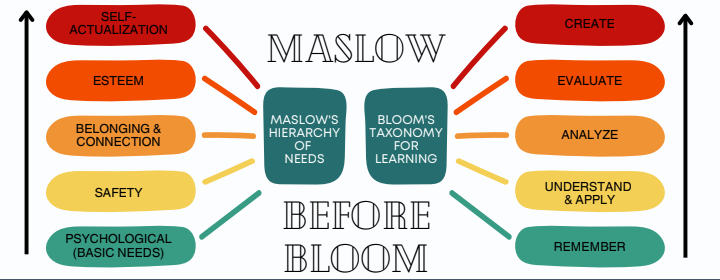
Yet, we often ask students to start at the top of the pyramid. We expect them to perform, achieve, and succeed without first addressing what is happening at the bottom. For many students in North Texas, the bottom of that pyramid is heavy.
Food insecurity.
Housing instability.
Anxiety.
Trauma.
Caregiving responsibilities.
Disconnection.
This is where Communities In Schools of North Texas steps in. Not as a program, but as people.
CISNT Site Coordinators are embedded in schools, building relationships with students and families and helping them navigate the challenges that stand in the way of learning. They connect families to food and resources, both in and out of school. They support academic, mental, and physical health needs. They provide consistency, care, and a trusted presence on campus. CISNT removes the barriers that make success possible.
When a student no longer has to worry about where they will sleep, they can worry about their homework.
When a teenager has someone helping them regulate fear and stress, they can focus on graduating.
When a family finds stability, children find room to breathe and to learn.
This is what it looks like when Maslow comes before Bloom.
The research now confirms what relationships have always shown us. The Harvard-led study featured in The Atlantic found that Communities In Schools not only improves attendance and graduation rates, but it also has a lasting impact well into adulthood. Students supported by CIS earn more later in life and are more likely to stay engaged in school and work.
But the true impact is not measured just by numbers.
It is the student who stayed in school because someone helped their family avoid eviction.
The teen who found their voice because a trusted adult made time to listen.
The family that learned how to ask for help and discovered they were not alone.
Trauma specialist Dr. Bruce Perry reminds us, “People, not programs, change people. The more healthy relationships a child has, the more likely they are to recover from trauma and thrive. Relationships are the agents of change.” This is the heart of our work at Communities In Schools of North Texas.
Because when one student stays in school, the ripple effects extend far beyond one classroom. Graduation leads to opportunity. Opportunity leads to stability. Stability leads to healthier families. And healthier families raise children who arrive at school ready to learn. This is what generational change looks like.
Communities In Schools of North Texas exists because students deserve more than survival. They deserve safety. They deserve belonging. They deserve the chance to imagine a future that is bigger than crisis.
We believe hope is built through relationships.
We believe learning begins with meeting basic needs.
We believe students bloom when someone shows up again and again and refuses to give up on them.
Let’s continue to meet needs before measuring outcomes, invest in people, not just programs, and help every child Maslow before they Bloom.
Thank you for being agents of change.
Interested in learning more about how to get involved with CISNT? Email give@cisnt.org.